

21 Nursing Hairstyles Ideas That Are Practical, Professional, and Pretty

Nursing is one of the most demanding professions in the world. Long shifts, constant movement, direct patient care, strict hygiene requirements — and somewhere in the middle of all that, you still need your hair to look professional and stay completely out of the way. That is a tall order for any hairstyle.
The good news is that nursing hairstyles have come a long way from the basic bun-and-done approach. In 2026, there are more options than ever for healthcare professionals who want hairstyles that are genuinely functional for a clinical environment while still looking polished, personal, and put-together. You do not have to choose between practical and pretty — the right nursing hairstyle gives you both.
In this article, we have put together 21 nursing hairstyles ideas with real, detailed descriptions, honest styling tips, and practical guidance for every hair type and shift length. Whether you work in a hospital, a clinic, a long-term care facility, or any other healthcare setting, this list has something that will work for your hair, your schedule, and your workplace requirements.
Let’s find your perfect nursing hairstyle.
What Makes a Great Nursing Hairstyle?
Before the ideas, it is worth understanding exactly what a nursing hairstyle needs to do — because the requirements are genuinely different from everyday hairstyling.
First and foremost, nursing hairstyles must keep hair completely off the face and away from patients. This is not just a preference — it is a patient safety and infection control requirement in most healthcare settings. Hair hanging forward over patients or equipment is a genuine hygiene risk.
Second, nursing hairstyles need to stay in place for an entire shift. Nurses work 8, 10, and 12-hour shifts with very little time for mirror checks or touch-ups. A hairstyle that falls apart by hour three is not a practical nursing hairstyle regardless of how beautiful it looks at the start of the shift.
Third, nursing hairstyles must be comfortable for long-term wear. A tight style that causes a headache by midday is counterproductive when you need to be focused and sharp throughout your entire shift. Comfort and security need to be balanced carefully.
Finally, nursing hairstyles should be clean, neat, and professional-looking for the clinical environment. Hair that looks disheveled or unkempt can affect patient confidence and professional perception. The best nursing hairstyles maintain their neat appearance from the beginning of the shift to the end.
21 Nursing Hairstyles Ideas

1. The Classic Secure Bun

The classic bun is the most universally used of all nursing hairstyles — and it earned that status by being genuinely excellent at its job. A properly secured bun keeps every strand of hair completely off the face, away from patients, and in place for an entire shift without requiring any touch-ups.
The key to making a classic bun work as a nursing hairstyle is security. Use a strong hair elastic, several bobby pins pushed in multiple directions through the bun, and a light application of hairspray to ensure nothing moves. A bun that wobbles or loosens throughout the shift is not a good nursing hairstyle — it needs to be genuinely locked in place.
Low buns are slightly more comfortable for long shifts because they do not create as much tension at the scalp as high buns. A low bun at the nape of the neck also stays under hats, surgical caps, and hair covers more easily, which is relevant for nurses who work in surgical or procedure-heavy environments.
Best for: All hair types, all shift lengths, universal nursing environments.
2. French Braid Into a Bun
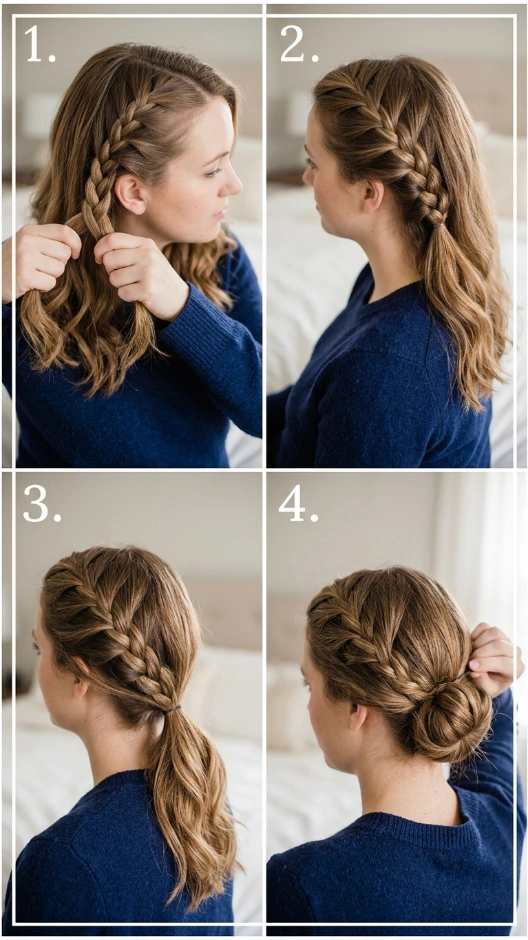
A French braid that feeds into a bun at the nape of the neck is one of the most secure and polished nursing hairstyles available. The French braid keeps all the hair along the scalp completely flat and controlled, and the bun at the end contains everything else. Nothing escapes, nothing falls forward, nothing moves.
The French braid into bun nursing hairstyle also distributes the weight of the hair more evenly than a simple bun, which makes it significantly more comfortable for long shift wear. Instead of all the tension being concentrated at one elastic, the braid distributes it along the entire length of the scalp.
This nursing hairstyle also looks very polished and professional — the braided section adds visual interest and intentionality that a plain bun lacks. It communicates that you took care with your appearance while still meeting every practical requirement of a clinical nursing environment.
Best for: Long shifts, thick and heavy hair, polished professional appearance.
3. Dutch Braid Into a Low Ponytail
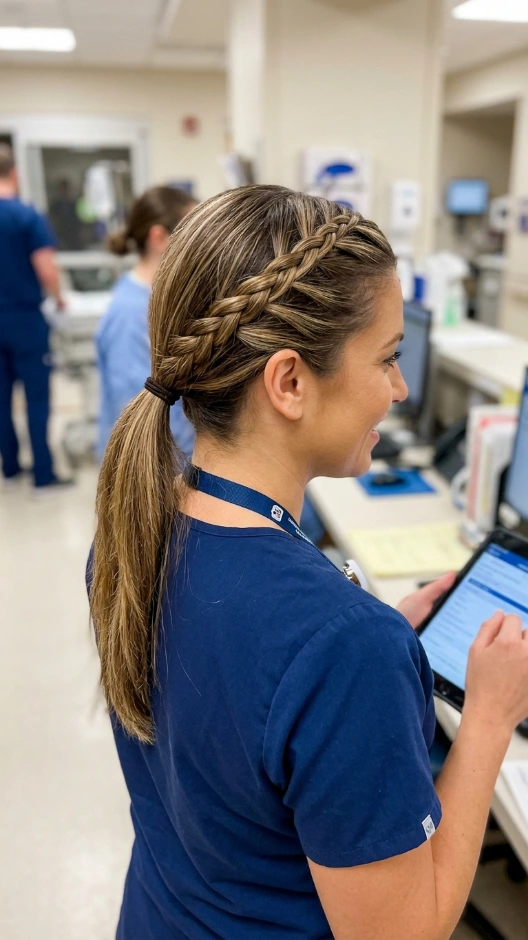
A Dutch braid that transitions into a low ponytail is a slightly more casual but very secure nursing hairstyle. The Dutch braid — where sections are crossed under rather than over, creating a raised, three-dimensional pattern — keeps scalp hair completely flat and secure from the front hairline to the nape, where it transitions into a neat, low ponytail.
This nursing hairstyle is particularly useful for nurses who find the weight of a full bun uncomfortable during long shifts but still need everything contained and off the face. The ponytail section can be tucked under a scrub cap or hair cover easily, making this nursing hairstyle very versatile for different clinical environments.
Dutch braid ponytail nursing hairstyles look very professional and deliberate. The visible braid section shows personal care and attention to appearance, which contributes positively to the professional image that nurses project to patients and colleagues alike.
Best for: Nurses who dislike heavy buns, clinical environments with head covers, professional appearance.
4. Sleek High Ponytail

A sleek, tightly secured high ponytail is one of the most practical and widely worn nursing hairstyles. It keeps all the hair pulled back from the face and neck, is fast to create on a busy pre-shift morning, and stays in place reliably throughout a shift when secured properly.
To make a high ponytail work as a nursing hairstyle, it needs to be genuinely secure. Use a strong, quality hair elastic that will not snap during a shift. Apply edge control or a smoothing gel to the scalp sections before pulling back to prevent flyaways and frizz from developing as the shift progresses. Wrap a small section of hair around the elastic to cover it neatly.
The sleek high ponytail nursing hairstyle is particularly popular among nurses who prefer a very clean, minimal look. It is quick enough to create on early morning shift prep — often under five minutes — and maintains its neat appearance throughout even the most demanding shifts.
Best for: Early morning prep, all hair types, clean and minimal professional look.
Read More: 21 Greasy Hairstyles Ideas That Actually Look Incredibly Chic
5. Braided Bun

A braided bun — where the hair is braided first and then the braid is coiled and pinned into a bun shape — is a beautiful and very secure nursing hairstyle that combines the security benefits of braiding with the complete containment of a bun.
Because the hair is already secured in a braid structure before being pinned into the bun shape, a braided bun is significantly more resistant to unraveling than a plain bun. The individual strands are already locked into the braid pattern, which means even if a few bobby pins loosen over the course of a shift, the overall structure remains intact.
Braided bun nursing hairstyles also look very elegant and professional. The visible braid coiled into a bun shape has a sophisticated, deliberate quality that elevates the basic nursing bun into something that genuinely looks beautiful. It takes about ten minutes to create but the security and the look are both worth the extra effort.
Best for: Long and very active shifts, all hair types, elegant professional appearance.
6. Low Ponytail With a Wrap

A low ponytail with a wrapped section is a clean, professional nursing hairstyle that looks significantly more polished than a basic ponytail with a visible elastic. Gather the hair into a low ponytail at the nape, secure with a strong elastic, and then take a small section of hair from the ponytail, wrap it around the elastic several times, and secure with a bobby pin underneath.
This nursing hairstyle is particularly good for environments where appearance standards are high — outpatient clinics, private healthcare practices, front-of-house nursing roles — because the wrapped ponytail communicates deliberate care and professionalism. It looks intentional rather than simply functional.
The low placement of the ponytail makes this nursing hairstyle very comfortable for long shifts, especially for nurses who spend a lot of time bending over patients or equipment. A high ponytail can create uncomfortable pressure when bending repeatedly — the low ponytail eliminates this issue entirely.
Best for: High-appearance nursing environments, long bending-heavy shifts, professional image.
7. Two Buns (Double Bun Style)

Two smaller buns — one on either side of the upper back of the head — distribute hair weight more evenly than a single bun and can be more comfortable for nurses with very thick or heavy hair who find a single large bun puts too much tension on one area of the scalp.
Double bun nursing hairstyles also sit lower and flatter against the head than a single large bun, which makes them easier to work under surgical caps, scrub caps, and other head covers without creating uncomfortable pressure points. For nurses who regularly wear head covers during procedures, this is a very practical advantage.
Create two small, neat buns rather than loose, messy ones to maintain the professional appearance required in clinical nursing environments. Secure each bun with its own strong elastic and multiple bobby pins. This nursing hairstyle may look playful in some contexts but when done neatly and at the correct height on the head, it reads as professional in a clinical setting.
Best for: Thick and heavy hair, nurses who wear head covers frequently, comfortable long-shift wear.
8. Cornrows Into a Bun
Cornrows that feed into a bun at the nape of the neck are an excellent nursing hairstyle choice for nurses with natural hair who want maximum security and minimum maintenance throughout their shift. Cornrows lie completely flat against the scalp, contain every strand of hair within the braided structure, and can last for several days — even a week or more — with proper nighttime care.
The combination of cornrows and a bun ensures that no hair escapes, falls forward, or moves during even the most physically demanding nursing shifts. Because the cornrows secure the hair directly against the scalp, there is no loose hair anywhere that could fall into the work environment.
Cornrow nursing hairstyles are also very low-maintenance throughout the shift. Once the cornrows and bun are in place at the start of the shift, they require no touch-ups, no reapplication of products, and no mirror checks throughout the day. For busy nurses with little time for self-care during shifts, this is an invaluable quality.
Best for: Natural hair, multi-day wear, minimum shift maintenance.
9. Twist Out With a High Bun

A twist out with the resulting defined coils gathered into a high bun is a beautiful and practical nursing hairstyle for nurses with natural curly or coily hair. The twist out creates beautiful, defined curls that look very polished and professional when gathered into a neat, secure bun.
The benefits of this nursing hairstyle are both aesthetic and practical. The defined curls from the twist out look much more intentional and polished within a bun than undefined, frizzy natural hair. The bun secures everything completely off the face and away from the clinical environment. And the natural curl definition from the twist out means the style looks beautiful even after a full shift when other hairstyles might look tired.
Do the twist out the night before to save time on shift prep mornings. Allow the twists to dry completely overnight, untwist in the morning, and gather into a bun immediately before leaving for work. The whole morning styling process for this nursing hairstyle takes under five minutes.
Best for: Natural curly and coily hair, overnight prep, polished professional appearance.10. Pineapple Updo for Natural Hair
10. pineapple nursing hairstyle

The pineapple updo — where natural hair is gathered loosely at the very top of the head and secured with a gentle hair tie — is a comfortable and very practical nursing hairstyle for nurses with longer natural hair. The pineapple placement keeps all the hair contained and away from the face and neck without creating the tension and potential breakage of a very tight, low bun.
For a nursing environment, the pineapple updo needs to be more secure than the typical casual pineapple style. Use a stronger elastic, add a few large bobby pins around the base, and consider wrapping a satin-lined scrunchie over the elastic for additional security and reduced hair breakage during long shifts.
The pineapple nursing hairstyle is also very kind to natural hair health compared to other styles — the loose gathering at the top creates much less tension than tight buns or very secure ponytails, which is important for nurses who wear demanding hairstyles day after day across many shifts per week.
Best for: Longer natural hair, hair health preservation, comfortable long-shift wear.
11. Knotless Box Braids Updo

Knotless box braids offer nurses with natural hair one of the best of all worlds — a protective style that maintains hair health, a professional appearance that meets clinical standards, and a variety of updo styling options that are all secure enough for nursing environments.
Knotless box braids can be gathered into high buns, low buns, ponytails, or twisted updos that all sit close to the head and keep hair completely off the face and neck. The knotless installation method — which begins without the traditional knot at the base — is also significantly more comfortable for long-term wear than traditional box braids, which matters for nurses who wear the style across multiple consecutive shifts.
Knotless box braid nursing hairstyles last for several weeks with proper care, making them extremely time-efficient — one installation provides a professional, secure nursing hairstyle for an entire month or more, significantly reducing the daily styling burden for busy healthcare professionals.
Best for: Natural hair, long-term wear, minimal daily styling, protective hair care.
12. Sleek Low Bun With Edge Control

A sleek low bun with perfectly laid edges is one of the most polished and professional nursing hairstyles available. Apply edge control gel to the hairline, use a small brush or toothbrush to smooth the baby hairs into clean, neat waves or straight lines along the hairline, and gather the hair into a sleek, tight low bun at the nape.
The edge control adds a significant level of polish and intentionality to the basic nursing bun that makes it look genuinely beautiful rather than just functional. Clean, laid edges around a sleek bun communicate attention to detail and personal care — qualities that are very aligned with the professional standards of nursing.
This nursing hairstyle works on all hair types but looks particularly stunning on natural hair where the defined, controlled baby hairs against the sleek bun create a beautiful contrast. It takes slightly longer than a basic bun but the result is a nursing hairstyle that looks truly professional and attractive throughout the entire shift.
Best for: Natural hair, high appearance standard environments, polished professional image.
13. Braided Ponytail

A braided ponytail — where the ponytail section itself is braided after gathering — adds security and control to a basic ponytail nursing hairstyle. The braid prevents the ponytail from swinging freely during movement and keeps the ends contained rather than flying around during fast-paced nursing work.
For nursing environments, a braided ponytail in a three-strand braid or a simple twist is very effective. The braid can be secured at the end with a small elastic and tucked up slightly for maximum containment. This is particularly useful in environments where nurses move quickly and change positions frequently.
Braided ponytail nursing hairstyles also tend to look very neat at the end of a long shift because the braided structure resists the frizzing and unraveling that plain ponytails often experience over the course of a 12-hour shift. The braid structure maintains its appearance much more reliably than loose hair.
Best for: Fast-paced nursing environments, long shifts, maintaining neat appearance.
14. Twist and Pin Updo

A twist and pin updo — where sections of hair are twisted and pinned flat against the head in an overlapping pattern — creates a very flat, secure nursing hairstyle that sits completely flush against the scalp with no protruding sections that could interfere with work or equipment.
This nursing hairstyle is particularly appropriate for nurses who wear close-fitting head covers or helmets, work in very tight clinical spaces, or have safety-related reasons to keep hair as flat and close to the head as possible. The twist and pin method achieves this better than almost any other nursing hairstyle.
The twist and pin updo also looks very elegant and deliberate — the pattern of overlapping twists across the head creates a beautiful, woven appearance that is very polished. It is a nursing hairstyle that is as beautiful as it is functional, which is the ideal combination for any healthcare professional.
Best for: Environments requiring flat, close-to-scalp hairstyles, head cover wear, elegant appearance.
15. Nurse Cap-Ready Rolled Style

In some formal nursing environments and ceremonial contexts — pinning ceremonies, formal healthcare events, historical uniforms — a rolled or set nursing hairstyle that works with a traditional nurse cap is the most appropriate choice. A smooth, rolled style with hair gathered neatly at the nape works beautifully under or with a nurse cap.
This nursing hairstyle draws on the classic, formal nursing aesthetic that has been part of healthcare culture for generations. A smooth, well-set rolled or pinned style communicates professionalism, tradition, and pride in the nursing profession. For ceremonial occasions in nursing, this type of formal nursing hairstyle is very appropriate and beautiful.
Even outside of ceremonial contexts, the rolled nursing hairstyle has a very polished, professional quality that works in high-end private healthcare environments where formal appearance standards are maintained. It takes more time to execute than a simple bun but the result is significantly more elegant.
Best for: Ceremonial nursing events, formal healthcare environments, traditional nurse cap wear.
16. Simple Two-Braid Style

Two simple braids — one on each side — gathered at the nape and secured together or pinned up into a bun create a very secure and comfortable nursing hairstyle that distributes the weight of the hair evenly across the head. The two-braid approach is particularly comfortable for nurses with very long or very thick hair.
The two-braid nursing hairstyle also has a very clean, deliberate look — the symmetry of the two braids is visually pleasing and communicates a neat, careful approach to personal grooming. When the braids are gathered and pinned neatly at the nape, the overall style looks professional and tidy from every angle.
This nursing hairstyle is very easy to create quickly on shift prep mornings — two simple braids take under ten minutes even on very long hair — and it maintains its appearance reliably throughout long shifts because the braided structure resists loosening and frizzing much more effectively than unbrained styles.
Best for: Very long and thick hair, quick morning prep, comfortable all-shift wear.
17. Secure Side Braid

A French or Dutch side braid that incorporates all the hair and ends at the nape of the neck — where it can be pinned up or secured flat — is a slightly asymmetrical but very secure nursing hairstyle that keeps all the hair completely off the face on both sides.
For clinical nursing environments, the side braid needs to be secured at the end so it does not swing forward during bending or movement. Pin the end of the braid up under itself against the nape, or tuck it into a small bun, to keep everything completely contained and off the shoulders.
Side braid nursing hairstyles add a gentle visual variety to the otherwise uniform look of nursing uniforms and scrubs. The slight asymmetry of the side braid creates visual interest without sacrificing any of the practical requirements of a clinical nursing hairstyle.
Best for: Variety from standard styles, all hair types, professional clinical environments.
18. Half-Up Tight Pin Style

A half-up pin style — where the top half of the hair is tightly gathered, pinned, or braided back while the lower half is gathered into a bun or low ponytail — creates a two-stage nursing hairstyle that is both secure and very polished.
This nursing hairstyle works especially well for nurses with layered hair where the shorter layers at the front tend to escape from a simple bun or ponytail. By addressing the front layers separately with pins or a small braid before gathering the rest, every single strand is accounted for and secured in place.
The half-up pin nursing hairstyle takes a few more minutes than a basic bun but the added security is well worth the extra time for nurses whose front layers are a recurring styling challenge during shifts.
Best for: Layered hair, escaping front layers, thorough all-strand containment.
19. Flat Twist Updo for Natural Hair

Flat twists — where sections of natural hair are twisted flat against the scalp in a cornrow-like pattern — create a very flat, completely secure nursing hairstyle that is particularly excellent for natural hair nurses. Flat twists can be arranged in various patterns before being gathered into a bun or pinned at the nape.
Flat twist nursing hairstyles sit very close to the scalp because the twist structure lies flat rather than raising above the head. This makes them ideal for environments where a low-profile hairstyle is required or preferred. They are also very comfortable for long-shift wear because the even distribution of tension across multiple flat-twisted sections prevents the concentrated pressure of a single bun or ponytail elastic.
Flat twist nursing hairstyles for natural hair also serve as a protective style — the flat twisting technique minimizes manipulation and friction during the shift, protecting the hair from breakage and damage that can accumulate over many shifts per week.
Best for: Natural hair, protective styling, flat low-profile hairstyle requirements.
20. Quick Pre-Shift Bun With Wet Hair

For nurses who shower before shifts and do not have time to fully dry and style their hair, a quick bun with slightly damp hair — secured tightly and allowed to dry throughout the early part of the shift — is a legitimate and very practical nursing hairstyle option.
Apply a small amount of leave-in conditioner or hair cream to damp hair before creating the bun to prevent excessive frizz as the hair dries. Secure very tightly with a strong elastic and multiple bobby pins so the wet weight of the hair does not cause the bun to loosen as it dries and lightens.
The wet bun nursing hairstyle will look sleek and polished for the first few hours of the shift as the hair is damp and smooth, and will transition into a slightly fuller, more textured bun as it dries — both versions look neat and professional in a clinical environment.
Best for: Pre-shift shower routines, early morning time constraints, all hair types.
21. Personalized Accessory Nursing Hairstyle

The final nursing hairstyle idea is less about a specific style and more about personalizing whichever secure nursing hairstyle you choose with a small, appropriate accessory that adds a touch of personality to your professional appearance. A scrunchie in a color that complements your scrubs, a small pearl clip on a neat bun, a pretty but secure hair pin on a French braid — small touches that make your nursing hairstyle feel personal and chosen rather than purely obligatory.
Personalized nursing hairstyles matter for morale and professional identity. Nursing uniforms are standardized, clinical environments are controlled, and the work day is demanding — a small personal touch in your nursing hairstyle is a very gentle way of maintaining individual identity and personal expression within a very regulated professional context.
Choose accessories that are secure, small, and unlikely to fall into clinical areas. Avoid large, dangling accessories, very sharp pins, or heavily embellished pieces that could pose safety risks in patient care settings. Within those sensible boundaries, personalizing your nursing hairstyle is both appropriate and genuinely beneficial for your daily wellbeing and professional confidence.
Best for: All nurses, personal expression within professional limits, daily morale.
Essential Tips for Nursing Hairstyles That Last a Full Shift
Invest in quality hair elastics. Cheap elastics snap during shifts — which is at best inconvenient and at worst a hygiene issue in a clinical environment. Strong, snag-free elastics designed for thick or heavy hair are worth every penny for nursing hairstyles.
Use bobby pins strategically. Place bobby pins in multiple directions — horizontally, vertically, and diagonally — around any bun or pinned updo to create maximum security. A bun secured with pins in only one direction is much more likely to loosen than one secured from multiple angles.
Apply hairspray before the shift. A light to medium hold hairspray applied after styling — particularly around the hairline and over the bun — significantly extends the lifespan of nursing hairstyles throughout long shifts. Reapplying is rarely possible during shifts, so getting it right at the start matters.
Consider scalp health. Wearing tight nursing hairstyles across multiple consecutive shifts can cause tension and breakage over time. Alternate the placement of your bun or ponytail slightly from shift to shift to distribute tension evenly. Use satin or silk hair ties rather than rough elastics to reduce breakage, and give your scalp and hair a recovery day between demanding styles when possible.
Keep a small emergency kit in your locker. A few extra bobby pins, a small elastic, and a travel-sized hairspray or edge control in your locker means you can quickly fix any nursing hairstyle issue that arises mid-shift without leaving your clinical area for long.
Match your hairstyle to your shift type. A 12-hour ICU shift requires a more robustly secured nursing hairstyle than a 4-hour outpatient clinic session. Calibrate the security and complexity of your nursing hairstyle to the demands of the specific shift you are working.
Hair Care for Nurses — Keeping Hair Healthy Despite Daily Styling
The demands of frequent nursing hairstyle styling — tight buns, daily elastics, constant containment — can take a real toll on hair health over time. Here are some important hair care practices for nurses:
Alternate your bun placement. Wearing a bun in exactly the same spot day after day creates concentrated tension at that point. Moving your bun slightly higher, lower, or to the side with each shift distributes the tension and reduces the risk of traction alopecia — hair loss caused by repeated tight pulling.
Use overnight treatments. On days off, apply a deep conditioning mask or a nourishing hair oil overnight to replenish moisture and strength lost to daily styling. This weekly or twice-weekly treatment significantly improves hair resilience over time.
Choose gentle hair accessories. Spiral hair ties, satin scrunchies, and snag-free elastics cause significantly less breakage than standard rubber elastics. For nurses who style their hair tightly and frequently, these gentler accessories make a meaningful difference to long-term hair health.
Trim regularly. Regular trims every eight to twelve weeks remove split ends that worsen over time due to friction from repeated bun styling. Healthy ends make nursing hairstyles look neater and more polished throughout the shift.
Final Thoughts
Nursing hairstyles are unlike any other category of hairstyle — they need to be secure, hygienic, professional, and comfortable across shifts that most people would find physically and mentally exhausting. That is a genuine challenge, and finding nursing hairstyles that meet all those requirements while still looking beautiful and feeling personal is a real achievement.
The 21 nursing hairstyles ideas in this article cover every hair type, every shift length, every clinical environment, and every personal style preference. From the simplest five-minute bun to the most polished braided updo, there is a nursing hairstyle here that will work for you.
You give so much of yourself in your work every single day. Your nursing hairstyle should be the least of your worries — secure, professional, and sorted before your shift even begins. Find your favorite from this list, make it yours, and then get back to doing what you do best.
Because the most important thing a nurse wears to work is never on their head — it is in their heart.


